
1. Introduction
In compressed air and industrial gas systems, coalescing filters and oil separators are often mentioned together—and frequently confused. here we will explore the coalescing filter vs oil separator difference.
Many buyers assume they perform the same function because both deal with oil and liquid removal. In reality, they work at different stages, solve different problems, and are not interchangeable.
Understanding the difference helps you Avoid wrong purchases, Reduce maintenance costs, Protect downstream equipment, and improve system reliability.
This article explains the difference in a clear, non-technical way, with real application examples you can relate to.
2. What Is a Coalescing Filter?
2.1 Definition and Working Principle
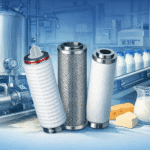
A coalescing filter element is designed to remove very fine liquid droplets (oil mist, water mist, condensate) from gas streams.
How it works, simply explained:
Tiny liquid droplets pass through fine fiber media
Droplets stick to fibers and merge into larger drops
Larger drops become heavy enough to drain by gravity
So instead of “blocking” liquid, a coalescing filter captures, merges, and drains it out continuously.
2.2 Typical Filter Media & Structure
Coalescing filters usually use Glass fiber or polyester fiber, composite fiber, Hydrophilic / oleophilic treated fibersand multi-layer gradient structures. It is a depth filter. if you want to know more about depth filter vs surface filter, check this article Filter Element Clogging Explained: Surface vs Depth Filtration.
This structure allows high separation efficiency (down to sub-micron droplets), low pressure drop and stable long-term performance.
2.3 Typical Applications
This is where coalescing filters really make sense. we give a Real Engineering Example to explain it.
In Petrochemical, Natural Gas & Chemical Gas Systems, there usually exist condensed hydrocarbons, Amine or glycol mist, Trace liquid carryover, These liquids can poison catalysts or block valves.
So a high-efficiency coalescing filter is installed before reactors, compressors, or metring stations.
Positive result:
Liquid droplets are removed before they cause damage
Catalysts last longer
Gas quality meets process requirements
👉 This application is critical in refineries, gas processing plants, and chemical production units.
3. What Is an Oil Separator?
3.1 Definition and Working Principle
An oil separator filter is a core component inside oil-injected compressors, especially screw compressors.
Its job is very specific, which include separate large amounts of lubricating oil from compressed air, Return the oil back to the compressor for reuse.
Oil separators work under high pressure, high oil concentration and continuous oil circulation.
They are not general-purpose filters.
3.2 Structure and Filter Media
Oil separators typically use: High-density fiberglass media, Multi-layer coalescing paper, Strong metal or plastic end caps
Integrated oil return paths.
Their design focuses on: High oil separation efficiency, Stable pressure drop, Long operating life inside the compressor.
3.3 Typical Applications
Oil separators are used only in compressors, such as: Screw air compressors, Rotary compressors, Sliding vane compressors
They are not installed in pipelines or downstream air systems.
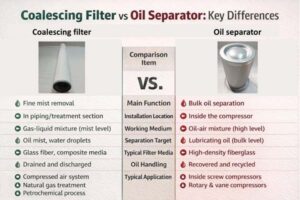
4. Key Differences Between Coalescing Filter and Oil Separator
5. Conclusion
While both deal with oil and liquids, coalescing filters and oil separators are designed for completely different tasks. In a word, Oil separators handle oil recovery, Coalescing filters handle air or gas purification. They solve different problems at different stages.
Understanding this difference helps you: Choose the right product, Avoid system failures, Reduce operating costs, Improve overall filtration performance.